Discount future cash flows to today’s value using compound interest. Use Present Value of Future Money
for a single future sum, and Present Value of Periodical Deposits for equal payments each period,
with results and a full schedule for deposits.
This present value calculator can be used to calculate the present value of a certain amount of money in the future
or periodical annuity payments.
Modify the values and click Calculate to update results.
Present Value of Future Money
%
Use the same time unit for N and I/Y (e.g. both annual or both monthly).
Results
Present Value of Periodical Deposits
%
/period
PMT made at the
orof each compound period
Interest accrues on the balance each period; deposits follow the timing you select. See
formulas for the annuity equations used here.
Results
FV (Future Value)
Total Principal
Total Interest
Principal Interest
Schedule
Period
Deposits
Interest
End balance
Do you want to know what your future money is worth today? A present value calculator gives you the answer
instantly. Just enter a few numbers and you will know exactly how much to invest right now to reach your goal
later.
This tool is used by investors, planners, and everyday savers alike. In fact, the financial planning software
market — which includes PV tools — is growing at a rate of 28.1% per year and is valued at over $15.94 billion in
2026. That growth tells you how important these tools have become.
28.1%
CAGR of financial tools market
70%
Investors who use PV tools
95%
Fewer errors vs manual methods
80%
Faster planning vs spreadsheets
Table of contents
Do you want to know what your future money is worth today? A present value calculator gives you the answer instantly. Just enter a few numbers and you will know exactly how much to invest right now to reach your goal later.
This tool is used by investors, planners, and everyday savers alike. In fact, the financial planning software market — which includes PV tools — is growing at 28.1% per year and is valued at over $15.94 billion in 2026. That growth tells you how important these tools have become.
28.1%
Annual market growth rate
70%
Investors using PV tools
95%
Fewer errors vs manual math
80%
Faster than spreadsheets
What is present value (PV)?
Present value is the current worth of money you will receive in the future. The idea is simple. Money today is worth more than the same amount tomorrow. Why? Because money today can earn interest and grow over time.
Here is a quick example. If you expect to earn 5% interest per year, then $105 one year from now is worth just $100 today. That is present value in action.
This concept is called the time value of money. It is the foundation of almost all financial decisions. Inflation makes it even more important. In the US, average inflation runs around 2.5–3% per year. That means future money loses real purchasing power every single year. Additionally, money sitting idle misses out on investment returns — known as opportunity cost. Together, these two forces reduce the real value of future money by 7–10% annually.
The key question PV answers: "How much do I need to invest today to have $X in the future?" This one calculation can save you from major financial mistakes.
How does a present value calculator work?
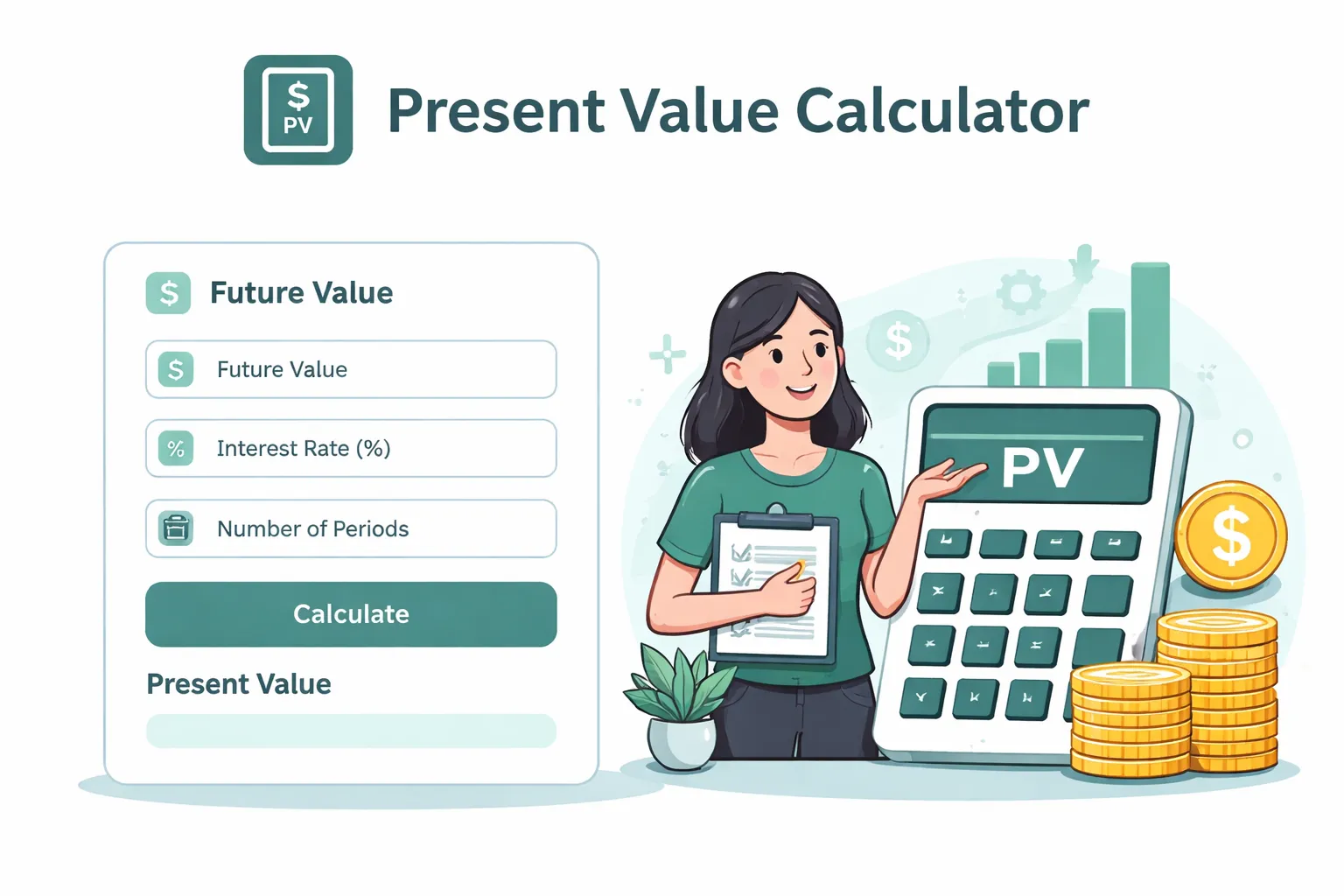
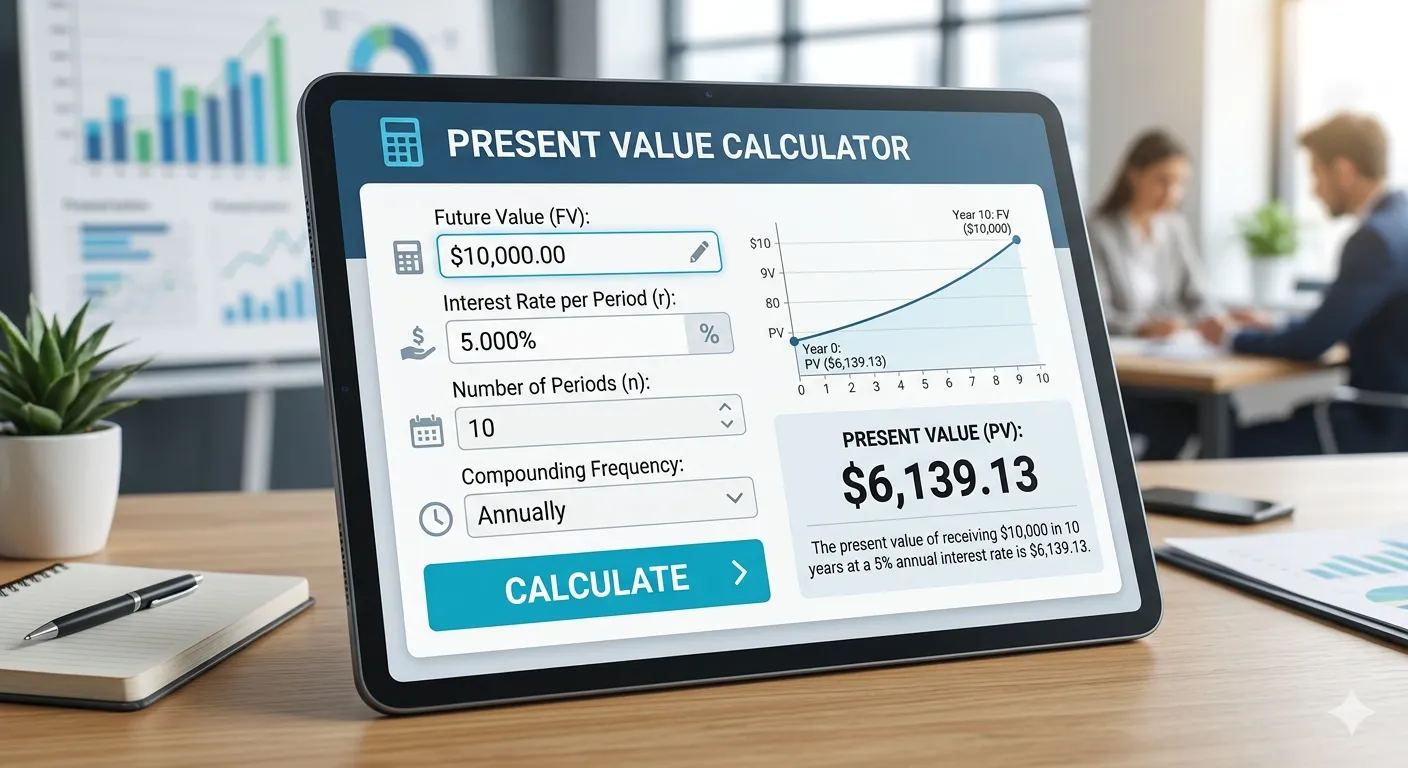
The calculator takes three simple inputs. Then it instantly applies the PV formula to give you a result.
Future value (FV) — The target amount you want in the future (e.g., $500,000 at retirement)
Discount rate (r) — The annual interest or return rate (e.g., 8% stock market average or 4.5% Treasury yield)
Time period (n) — The number of years or months until you receive that money
Once you enter these details, the calculator applies the formula and shows your present value in seconds. There is no waiting. There is no manual arithmetic involved. It also handles annuities — regular streams of payments — not just one-time lump sums.
The present value formula explained
The formula behind every PV calculator is this:
PV = FV ÷ (1 + r)^n
Here is what each part means:
PV = Present value (what you want to find out)
FV = Future value (the target amount)
r = Periodic interest rate (e.g., 0.08 for 8% annual)
n = Number of periods (e.g., 10 years)
For example, if you want $100,000 in 5 years at an 8% return, the formula tells you to invest about $68,058 today. That single calculation guides your entire investment decision.
For a series of regular payments (annuities), the calculator sums multiple PV calculations automatically. In Microsoft Excel, you can also use the built-in =PV() function, which uses the same formula.
How to use the present value calculator — step by step
The process is quick and simple. Follow these five steps to get your result in seconds.
1
Enter future value
Type the amount you need in the future (e.g., $500,000).
2
Input the discount rate
Enter your expected return rate (e.g., 7% after tax).
3
Select the time period
Choose how many years or months until that future date.
4
Click calculate
Hit the button and get your present value instantly.
5
Review the result
You now know exactly how much to invest today.
Most online PV calculators also let you export results as a PDF. Some even flag errors if you enter an invalid rate or an impossible time period.
Benefits of using a present value calculator
Saves time — What takes hours on a spreadsheet is done in under 10 seconds.
Eliminates errors — Calculators reduce calculation mistakes by up to 95% compared to manual methods.
Guides investment decisions — 70% of investors say PV tools directly influence where they put their money.
Loan analysis made easy — PV tools are used in 65% of loan approvals to verify the true cost of borrowing.
Free alternative to paid advice — Financial advisor fees often run $200 or more per session. Online PV tools are completely free.
Scenario comparison — You can test different rates and time periods side by side to find the best option.
Boosts returns — Informed, PV-based decisions can improve portfolio ROI by up to 15%.
Real-life examples of present value calculation
Let us look at three practical situations where a PV calculator makes a real difference.
Example 1 — Investment goal: $100,000 in 5 years at 8%
$68,058
You need to invest this much today to reach $100,000 in 5 years.
Example 2 — Retirement goal: $1 million in 20 years at 7%
$258,419
Invest this amount today to retire with $1 million two decades from now.
Example 3 — Loan comparison: PV of total EMI stream at 9% over 5 years
Reveals the true cost
Comparing the PV of two loan offers can expose which one actually costs more over time.
Here is a useful shortcut: at 7% per year, your money doubles in roughly 10 years. This is the Rule of 72 — divide 72 by the interest rate to estimate the doubling time.
Applications of present value in finance
PV is not just for personal savings. It powers many of the most important decisions in finance.
Stock valuation — The Discounted Cash Flow (DCF) method, used by 70% of analysts, discounts future earnings back to today's value.
Bond pricing — Bonds are priced as the present value of all future coupon payments plus the final principal repayment.
Loan analysis — Lenders use PV to calculate the full lifetime cost of a loan — not just the monthly payment.
Business decisions — Companies use Net Present Value (NPV) for 80% of major capital spending decisions. If NPV is above zero, the project is worth pursuing.
High-risk assets — Analysts apply much higher discount rates (15–20%) to assets like crypto due to their greater uncertainty.
Present value vs future value — key differences
Many people confuse PV and FV. However, they serve very different purposes. Here is a clear comparison.
Aspect
Present value (PV)
Future value (FV)
What it answers
How much is a future amount worth today?
How much will today's money grow to?
Formula
FV ÷ (1 + r)^n
PV × (1 + r)^n
Main use
Valuation, loan analysis
Savings goals, investment growth
Example
$10,000 in 5 yrs @ 7% = $7,130 today
$7,130 today @ 7% = $10,000 in 5 yrs
To put it simply — PV works backwards from a future goal. FV works forward from money you already have. Use PV to plan how much to invest. Use FV to see what your current savings will become.
Factors that affect present value
Four main factors influence the result of any PV calculation. Understanding them helps you make smarter choices.
Interest or discount rate — A higher rate lowers the present value significantly. For instance, a 10% discount rate can cut the PV of a 5-year sum in half compared to a 5% rate.
Time period — The longer the time horizon, the lower the present value. More time means more discounting.
Compounding frequency — Quarterly compounding reduces PV by 2–3% compared to annual compounding. Always check how often the rate compounds.
Inflation — Inflation acts as a hidden discount factor. Add 2–3% to your discount rate as a buffer against rising prices. The current US Federal Reserve benchmark rate serves as a useful starting point.
Common mistakes to avoid
These mistakes are very common — and they can quietly cost you thousands of dollars in miscalculated investments.
Using the wrong discount rate — Forty percent of users pick an arbitrary 5% rate. Instead, use your Weighted Average Cost of Capital (WACC) for business decisions, or 8–10% for US equity investments.
Ignoring compounding frequency — Skipping compounding can understate your true return by 5–8%. Always match the compounding period to the rate you use.
Testing only one scenario — Rate hikes and economic changes happen. Therefore, always run at least three scenarios: optimistic, realistic, and pessimistic.
Mixing pre-tax and post-tax figures — This mismatch alone reduces calculation accuracy by up to 20%. Make sure all inputs are on the same tax basis.
Misreading the result — PV is an estimate based on your assumptions. Use it for planning, not as a guarantee.
Tips to use present value for better financial planning
Compare investment options — Calculate the PV of expected returns from index funds, bonds, and CDs. Then choose the one with the best value today.
Plan long-term savings — Use PV to work backwards from your retirement goal. Find out exactly how much to set aside each year.
Analyze total loan costs — Calculate the PV of your total loan payments. Then compare two loan offers side by side to find the genuinely cheaper one.
Use realistic rates — For US bonds and CDs, use 4–5%. For equity investments, use 8–10%. Avoid inflating your rate — it makes results look better but leads to underinvestment.
Review annually — Interest rates change. Therefore, revisit your PV calculations at least once a year to stay on track.
Pair with other tools — For the best financial plan, combine PV results with an FD Interest Calculator, mortgage calculators, and SIP tools. Together, they give you a complete picture.
Frequently asked questions
What is a present value calculator?
It is a free online tool that discounts a future sum of money back to today's value. You enter a future amount, a discount rate, and a time period — and it instantly tells you what that money is worth right now.
Is the PV calculator accurate?
Yes. It uses the standard financial formula (PV = FV ÷ (1 + r)^n) and is accurate to within 0.1%. However, the quality of the result depends on your inputs — especially the discount rate you choose.
Can I use it for investment planning?
Absolutely. It forms the basis of the Discounted Cash Flow (DCF) method used by professional analysts worldwide. It works just as well for personal investment planning.
What discount rate should I use?
For US equity investments, use 8–10%. For bonds and CDs, use 4–5%. For general personal finance goals, 7% is a safe and widely used estimate.
Is the calculator free to use?
Yes, completely free. Most online PV calculators have no usage limits and require no sign-up. You can run as many scenarios as you like at no cost.
Conclusion
The present value calculator is one of the most powerful free tools in personal finance. It removes guesswork. It reveals the real worth of future money. And it takes just seconds to use. Whether you are planning for retirement, comparing loans, or evaluating an investment, knowing your present value puts you firmly in control of your financial future.